Clemson Flower Color Project
  • Home
  • About Us
  • Protocols
  • Research Updates
  • Contact
  • Target Species Information

Updates from our researchers!

January 2026:
We’re working to increase engagement with a new Instagram account. Check it out! 

December 2025:
We hosted a webinar with updates on the project and preliminary results. We’re excited about how many of your photos we’ve analyzed and are starting to make some sense of the data!


​November 2025:
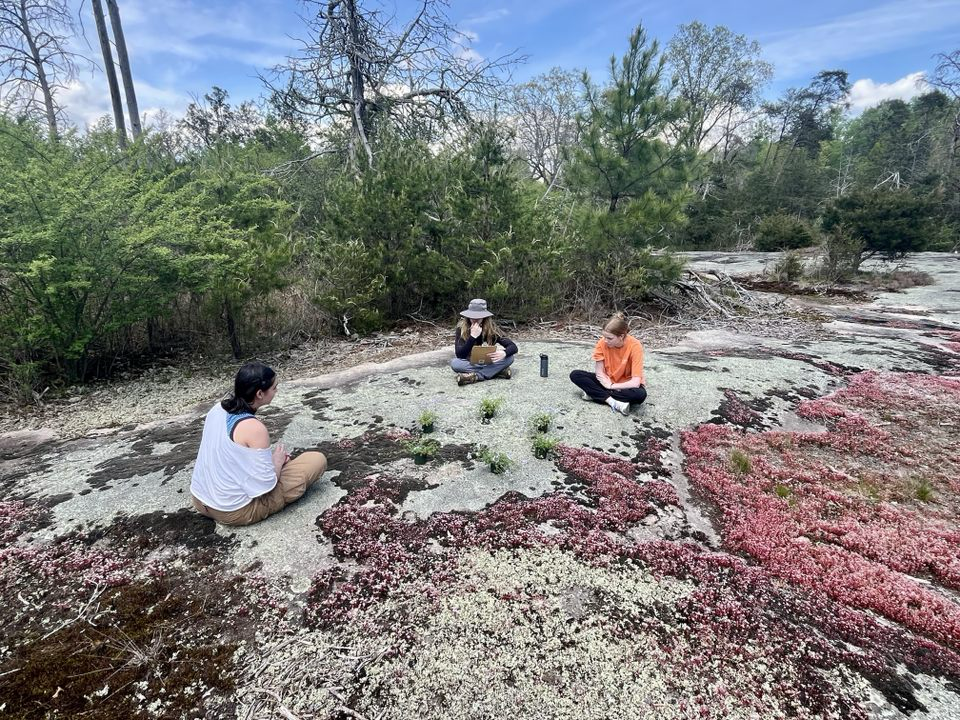
We taught 4-H Junior Naturalists from the South Carolina Botanical Garden about pollination and flower color. They got to track bumblebee visitation to plants of Phacelia dubia against green and gray backgrounds. 
02/17/2025
Picture
Houstonia caerulea (red)
Phacelia dubia (blue)

​Question 1: Has flower color evolved to increase contrast with local backgrounds?
Prediction: Flowers will reflect more in the green range (be whiter) against greener backgrounds.
Results: There is a tendency for flowers to reflect more green when background is greener, P= 0.42, therefore is not significant
We reject prediction 1- Flowers reflected more in the green range against greener backgrounds but trend not significant

​By comparing the green chroma of the flowers (y-axis) to the green chroma of the background (x-axis), we are able to observe if there is a correlation between flowers appearing more white and green backgrounds. While we do observe a tendency towards flowers to be whiter against greener backgrounds, the P- value is too high to be considered significant. 

​Question 2: Is flower color structured spatially?
Prediction: Flowers will be whiter at lower latitudes
Results:
Picture
Flowers are whiter at lower latitudes. P= 0.02 (figure 1) 

​Houstonia caerulea (red)
Phacelia dubia (blue) ​    ​

Picture
Flowers are darker under higher sun exposure. P= 0.035 (figure 2) 

Houstonia caerulea (red)
Phacelia dubia (blue)​

We accept prediction 2-  Flowers were lighter at lower latitudes and darker under higher sun exposure
In figure 1, it is shown that there is a correlation between higher green chroma and lower latitude and 
lower the green chroma and higher latitude. The P-value shows that this is significant, showing that flowers will appear whiter at lower latitudes (more south) and appear more purple at higher latitudes (more north). This trend can be supported by previous studies that darker flowers are able to warm reproductive flower structures through increased solar absorption, leading to more reproductive success in cooler climates, i.e. higher latitudes

10/09/2024

Our lab has received around 300 photo submissions spanning 6 states from 12 participants! Thank you to all participants!
06/10/2024
We have developed a new protocol that allows us to accept more image formats - therefore making our project accessible for anyone with a mobile device!
Picture

04/24/2024

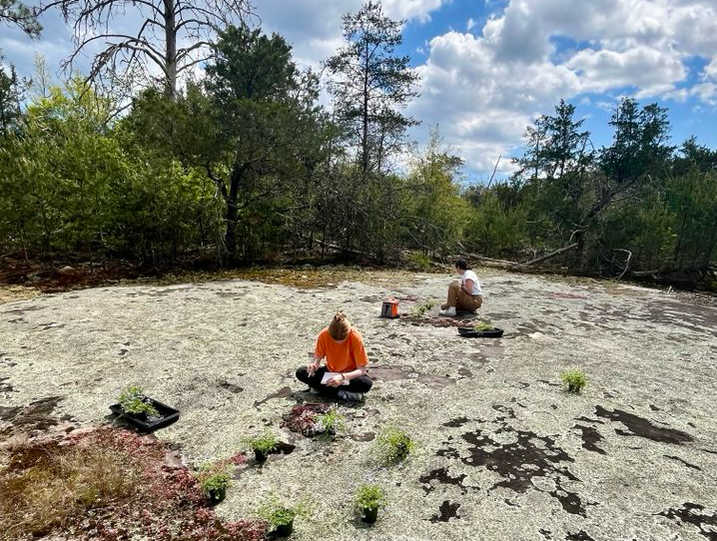
The undergraduates have been observing pollinator visitation to arrays of potted plants in local outcrop and meadow environments to assess color preferences.

Picture
Picture

04/12/2024

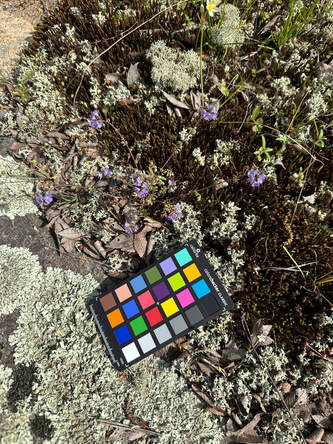
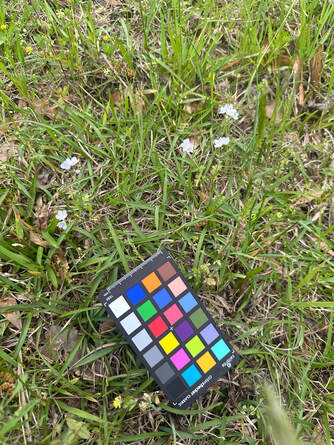
Color checker pictures taken by our lab technician, Taylor! Phacelia dubia photographed in a meadow environment and an outcrop environment.
Picture
Picture
04/8/2024
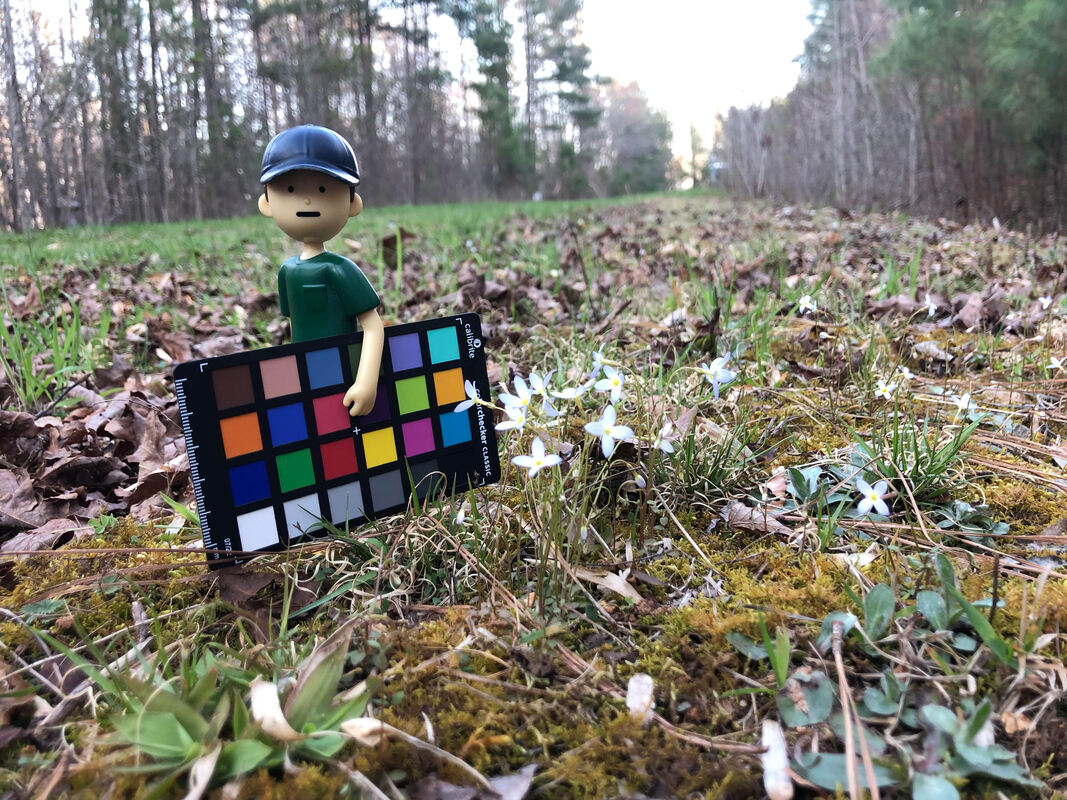
Field work season begins!
Our data collection can commence with our phacelia in bloom!  We even have some helpers (thanks @TinyJooning):
Picture
​04/05/2024
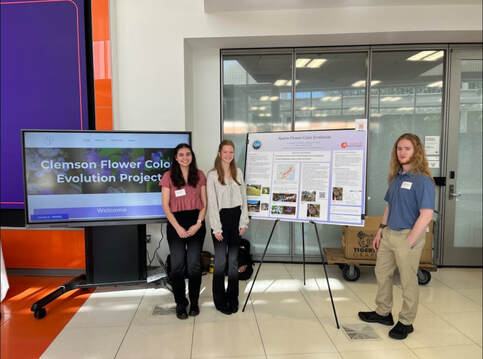
Our undergraduates presented at the Clemson Focus on Creative Inquiry Poster Forum, also known as FoCI!
Picture

​02/15/2024

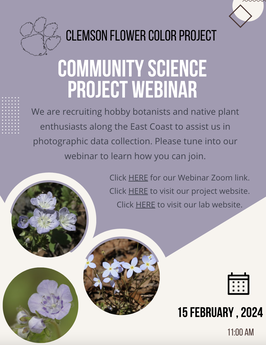
Tune into our upcoming Webinar to learn how to get involved with our project!
​Click the image below to access our online flyer.
Picture

1/4/2024

Welcome Caroline, Amelia, Jessica, and Eamon, our newest undergraduate researchers!

Picture
Powered by Create your own unique website with customizable templates.
  • Home
  • About Us
  • Protocols
  • Research Updates
  • Contact
  • Target Species Information